Smishing: Why RCS Is the Solution for Businesses

Alexia Moustier
Share :
Smishing has made your customers wary of all SMS, including yours. RCS solves this problem at its root: every sender is verified by Google and mobile carriers before sending a single message. Identity theft is technically impossible. It’s not just a security feature—it’s a requirement for accessing the channel.
Introduction
More and more people are falling victim to smishing. This phishing technique involves sending fraudulent messages that trick recipients into revealing confidential information (passwords, bank details, Social Security numbers, etc.) by impersonating legitimate organizations such as banks, delivery services, and government agencies.
The problem isn’t limited to the direct victims. For businesses, the consequences are twofold: not only are their customers targeted by scammers impersonating them, but—and this is less often mentioned— their own legitimate messages have also come under suspicion. Mistrust has become widespread. A SMS unknown number, even if it’s genuine, is now ignored, deleted, or even reported.
RCS provides a structural solution to this problem. It’s not just an additional layer of security, but a fundamental change to the protocol that makes identity theft technically impossible by design. Let us explain.
Smishing costs businesses more than people realize
The usual instinct is to measure the impact of smishing through the lens of the victims: people who have been scammed, money that has been stolen, and data that has been compromised. This is a reality. But this perspective obscures an indirect cost that directly affects companies that send SMS .
When your customers receive SMS every day that impersonate their bank, mobile carrier, or delivery service, they develop a reflexive distrust . This reflex does not distinguish between scammers and legitimate senders. It applies to all SMS or transactional SMS , without exception.
Certain sectors, such as debt collection, debt settlement, or, more broadly, billing, are prime examples of this. A payment reminder sent via SMS—even if it comes from a perfectly legitimate organization, with a clear subject line and a valid link—is now perceived as a scam attempt by a growing number of recipients.
The result: plummeting open rates, delayed payments, unnecessary verification calls, and skyrocketing processing costs.
The same logic applies to medical reminders, bank notifications, delivery confirmations… anywhere a message needs to trigger an action and the recipient’s skepticism gets in the way.
Why SMS solve this problem
Skepticism toward SMS unfounded. It stems from the very nature of the SS7 protocol, which was designed at a time when fraud on this scale was not anticipated.
Until 2023, anyone could set up an alphanumeric sender name for an SMS “BankXY,” “Chronopost,” “Ameli”) without any verification. Operators and aggregators have made significant progress in identity verification. Chains for validating legitimate senders have been created, fines are being issued, but the end recipients do not have this information, and the SMS protocol SMS allow for distinguishing between genuine and fake messages.
This isn’t a bug that can be fixed. It’s an architectural limitation. Adding legal notices, style guides, or HTTPS URLs to an SMS change anything: the fraudster can do exactly the same thing. The problem is the similarity, and SMS way of preventing it.
RCS makes smishing impossible: how it works
RCS Business Messaging does not provide additional protection for SMS. It operates on a different protocol, with a radically different access mechanism. And that is what makes all the difference.
To send an RCS message on behalf of a brand, a company must create what is known as an RCS agent. This agent is not merely a technical configuration; it is an entity that must undergo a mandatory two-step validation process.
Step 1 — Google Verification
The RCS agent is subject to Google RCS Business Messaging. Google verifies the company’s identity, the authenticity of the brand, and the compliance of the declared use case. An unverified agent simply cannot send RCS messages.
Step 2 — Validation by operators
Once approved by Google, the agent must be activated with the mobile carriers (in France: Orange, SFR, Bouygues, Free). Each carrier applies its own compliance criteria. It is this two-step process—Google plus the carriers—that constitutes the barrier to entry.
What this results in for the recipient
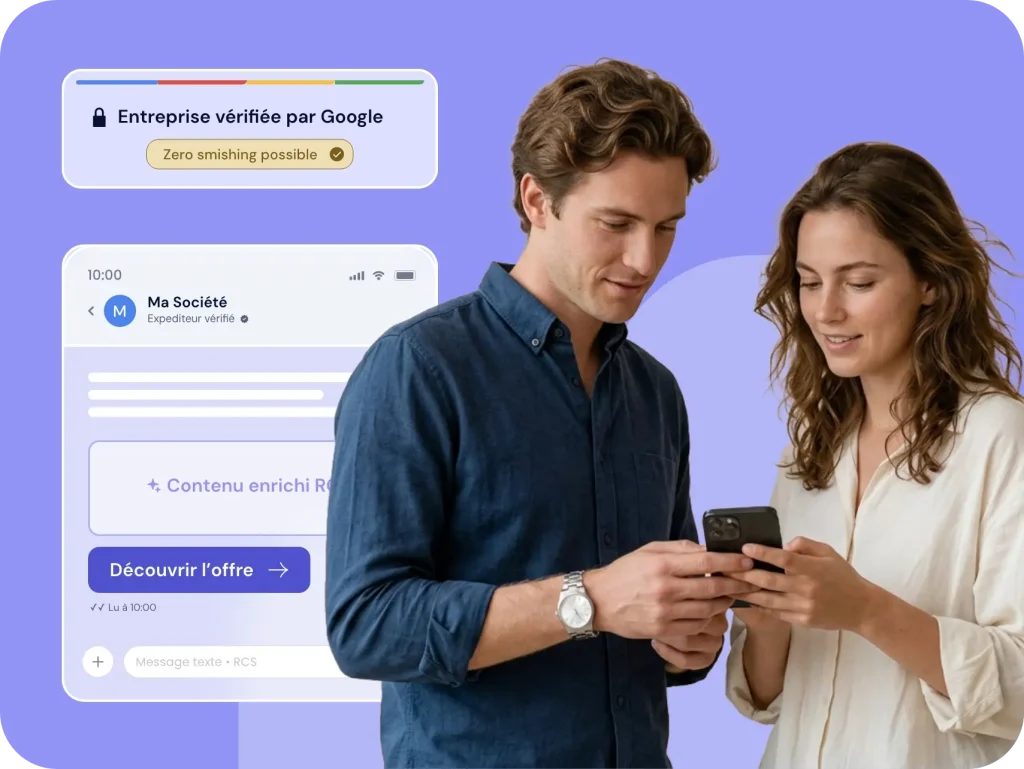
When an RCS message arrives on your customer’s phone, it appears in the native messaging app with your brand’s verified name, your logo, and a certification badge that’s visible even before the message is opened. This isn’t an option you have to enable. It’s what the channel displays by default for any sender who has passed validation.
It is technically impossible to send an RCS message by impersonating a registered brand. RCS smishing does not exist. Not because fraudsters haven’t tried it, but because the channel’s structure does not allow for it.
What this means in practice for your recipients (and your business)
The most direct impact is psychological, in the positive sense of the word: your customers immediately know who they’re dealing with. Even before opening the message, they see your verified brand identity. The question “Is this a scam?” no longer arises—the channel answers it by design.
In sectors where mistrust is strongest, the gains are most measurable.
- Debt collection and receivables: A settlement notice sent by an identified and verified RCS agent is treated as an official communication, not as a phishing attempt. Response rates are rising significantly.
- Banking and insurance: Security notifications, transaction alerts, and appointment reminders carry the same level of credibility as a call from a known number.
- Healthcare: Appointment reminders, pre-operative instructions, or test results may be provided with a level of confidentiality that is incompatible with SMS .
- Logistics: Delivery confirmations and rescheduling requests—which are often targeted by fraudsters—are regaining their original credibility.
The smsmode statistics© :
In an A/B test SMS RCS for reminders regarding unpaid invoices, RCS results in +12 action points on the payment portal compared to SMS, and a 11% increase in the collection of overdue payments. (Source: campaigns conducted by Spacinov using smsmode)©)
Beyond reliability, RCS introduces metrics that SMS offer: read receipts, interaction rates, and clicks per button. For high-stakes communications (follow-ups, reminders, activations), this represents a fundamental shift in the ability to manage these interactions.
How to integrate RCS to secure your communications
Integrating the RCS does not require a complete overhaul of your messaging strategy. It is part of a phased approach, starting with the messages where recipient distrust is most costly.
- Identify your priority messages —those where open or action rates are dropping, where you’re receiving verification calls, or where mistrust is a documented barrier.
- Register your RCS agent via smsmode©. We assist with the creation and submission of the agent to Google and mobile carriers. The process is guided step by step.
- Choose your delivery method —via our documented REST API or in agency mode if you’d like to outsource the entire process.
- Conduct an initial test on 1 or 2 targeted use cases, using predefined metrics (read rate, action rate, volume of incoming calls).
- Start small and gradually expand to other areas where RCS can add value.
Guaranteed continuity: if a recipient is not yet RCS-compatible (approximately 15% of users in France), the SMS fallback automatically takes over. No messages are lost. RCS reach now stands at 85% (May 2026, Ed.) of French smartphones (source: Af2m) and is growing every week.
AGENCY SERVICE
Launch your RCS campaign
Try RCS without having to handle the setup.
Discover agency mode →
Ready to secure your RCS communications?
Contact our team to get started on creating your RCS agent and identify the initial use cases best suited to your business.
FAQ — Smishing and RCS Protection
Can RCS really prevent smishing?
Yes, structurally. Unlike SMS, RCS requires each sender to be verified by Google and mobile carriers before any messages are sent. It is technically impossible to send an RCS message by impersonating a registered brand.
Is the RCS agent registration process complicated?
No, but it's got everything: brand information, stated use cases, visuals… smsmode© supports the entire submission process. The approval time varies by operator, generally ranging from a few days to a few weeks.
Should you replace all your SMS RCS?
No. SMS the best channel for universal coverage—it reaches 100% of phones. RCS is best suited for situations where the recipient’s trust is at stake: reminders, high-stakes notifications, and communications in sectors prone to mistrust. The two channels work together, with an SMS fallback for non-compatible devices.
Is the RCS suitable for small and medium-sized businesses, or only for large companies?
The RCS is available to all businesses, regardless of size. Registration with the RCS does not require a minimum volume of messages. An SME that sends appointment reminders or payment reminders benefits from exactly the same authenticity guarantees as a large enterprise.
Which sectors benefit most from RCS security?
The sectors where recipients’ mistrust is strongest and most costly: debt collection and settlement, banking and insurance, healthcare, logistics, and any sector where SMS identity theft SMS documented or is suspected by your customers.
Try out our SMS platform and benefit from 20 free test credits, with no obligation.