
Share :
Introduction
In the face of the constant rise in fraud, authentication methods are being forced to evolve rapidly. New techniques, such as passkeys and biometrics, are becoming increasingly common and promise a user experience that is both smoother and more secure. But despite all these new systems, OTP- SMS s still play a vital role in 2026—why is that?
The OTP web SMS
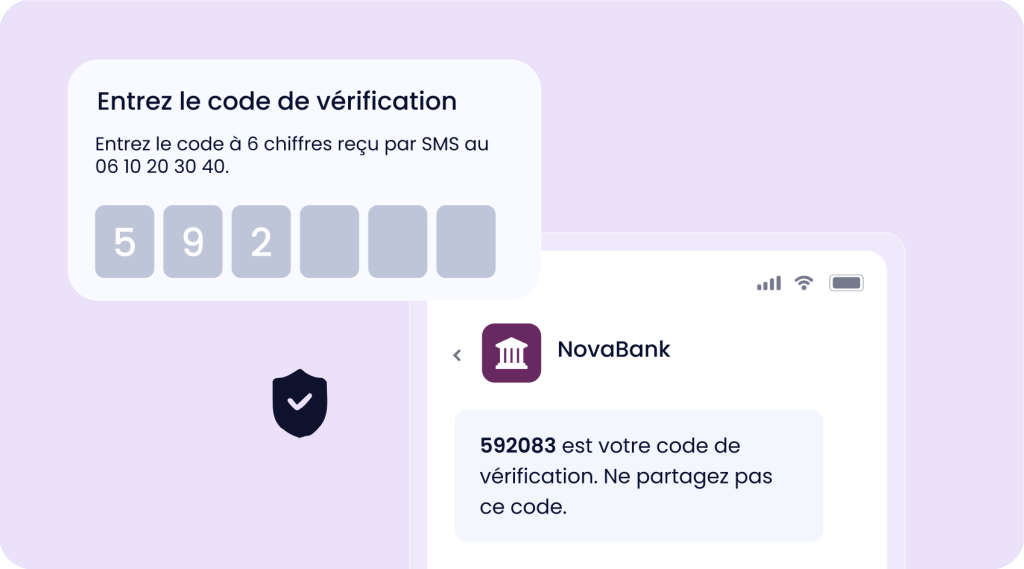
A SMS OTP is a message SMS containing a temporary, secure code sent to a user’s phone to verify the user’s identity during authentication.
This is a randomly generated 4- to 8-digit code that can be used only once and expires a few minutes after it is sent. Thanks to this two-factor authentication method, companies can better protect their customers.
New methods that don't match the OTP " SMS " in every respect
New techniques are available, such as biometrics-based passkeys or TOTP codes stored solely on the customer’s device (e.g., the iOS Passwords app).
Passkeys are attracting more and more technology platforms. They offer a high level of security against phishing thanks to their authentication based on cryptographic keys and the ability of smartphone operating systems to detect malicious websites.
But not all companies can switch to this new technology. On the one hand, because their customers use different devices and operating systems, and not all of them have enabled this new authentication method; and on the other hand, because not every company can afford to invest in this technology. In these cases—and also as a “backup” for all new authentication solutions— SMS s remain essential for businesses.
OTP " SMS ": A Simple Solution
Capable of reaching all users with a mobile phone, the OTP “SMS ” is a universal solution. Whether it’s to confirm a login, verify an identity, validate a sensitive transaction, or create a new account, the OTP “ SMS ” remains a reliable and accessible solution. Unlike authentication apps, access keys, or passkeys, the OTP SMS requires no installation, no additional account, and no prior setup—all you need is a phone number. These are clear advantages for businesses looking to quickly and easily secure the user experience.
Quick Integration for Businesses
From a technical standpoint as well, the OTP web SMS continues to be highly regarded.
Thanks to the APIs SMS and numerous open-source solutions, it can be integrated quickly. Companies can therefore secure connections, registration validations, transaction confirmations, and changes to sensitive data. That is why OTP SMS remains widely used by developers across many industries.
The OTP web SMS s meets numerous regulatory requirements
In many regulated industries, strong authentication has become mandatory.
OTP ( SMS ) therefore remains a widely used solution by banks, insurance companies, e-commerce platforms, and public services to secure sensitive transactions.
An ideal solution as a means of recourse
Even as companies gradually adopt access keys and the systematic use of biometrics, they continue to rely on OTP ( SMS s). This serves as an excellent fallback mechanism when a user changes phones, a device is lost or stolen, a passkey is no longer available, or biometric authentication fails. It allows for quick verification of the user’s identity without blocking their access to the service.
The two solutions are complementary: passkeys provide robust authentication on compatible devices, while the OTP SMS supports users who do not yet have—or do not currently have—access to these technologies. It secures user journeys across heterogeneous environments and provides backup access in case of unforeseen circumstances.
Many experts recommend maintaining an alternative mechanism in 2026 to ensure the continuity of authentication processes.
ANSSI's Recommendations on OTP " SMS "
The ANSSI (National Agency for Information System Security) recommends prioritizing robust methods such as passkeys or security keys that comply with the FIDO2 standard.ANSSI also acknowledges that OTP-SMS ation is more secure than authentication based solely on a simple password. This solution is therefore suitable for many uses, provided it is combined with other security measures and used in an appropriate context.
The Limitations of the OTP " SMS "
Although it remains widely used, OTP- SMS s are not without risks. Several types of attacks can compromise their effectiveness when used alone. One such risk is phishing. A person may be tricked into entering their OTP code on a fake website that mimics an official platform; the code is then captured by an attacker, who can use it before it expires. Another threat is SIM swap fraud, which involves fraudulently transferring the victim’s phone number to a new SIM card in order to receive auth SMS . This type of attack is targeted but can have significant consequences.
Finally, the "SMS " also depends on the mobile network. In the event of poor coverage, a delay in message delivery, or an unavailable phone, a person may have difficulty completing the authentication process.
These limitations explain why OTP ( SMS ) is now considered an effective authentication factor, but one that must be part of a comprehensive security strategy.
Learn the steps you need to take to protect yourself
Best Practices for Secure Use of the OTP " SMS "
The effectiveness of the OTP “ SMS ” also depends on how it is implemented.
To improve your security, here are some best practices:
- limit the code's validity to a few minutes;
- generate a complex random code;
- create one-time codes;
- Implement rate limiting based on the number of attempts or the IP addresses used
- limit the number of login attempts to prevent attacks;
- clearly inform the user that they must never disclose their code to a third party;
- Choose a reliable SMS service provider like smsmode©.
Thanks to smsmode© companies benefit from a platform for sending professional e SMS s that is hosted in France, ISO 27001-certified, GDPR-compliant, and designed to ensure fast and secure delivery. These measures help reduce risks while maintaining a seamless experience.
The OTP web SMS continues to evolve with new learning paths
The future of authentication does not rely on a single technology, but on various complementary solutions.
Companies can set up workflows that automatically use the most appropriate method based on the context: passkeys on compatible devices, biometric authentication when available, and OTP- SMS s when a fallback mechanism is needed.
These various methods helpimprove security, accessibility, and connection success rates.
Try out our SMS platform and benefit from 20 free test credits, with no obligation.